By Nicola Gailits, as seen in the Reep Green Solutions Tree Trust Blog
Da Vinci says that “to see is to know.” Most of us don’t see trees, we drive past them.
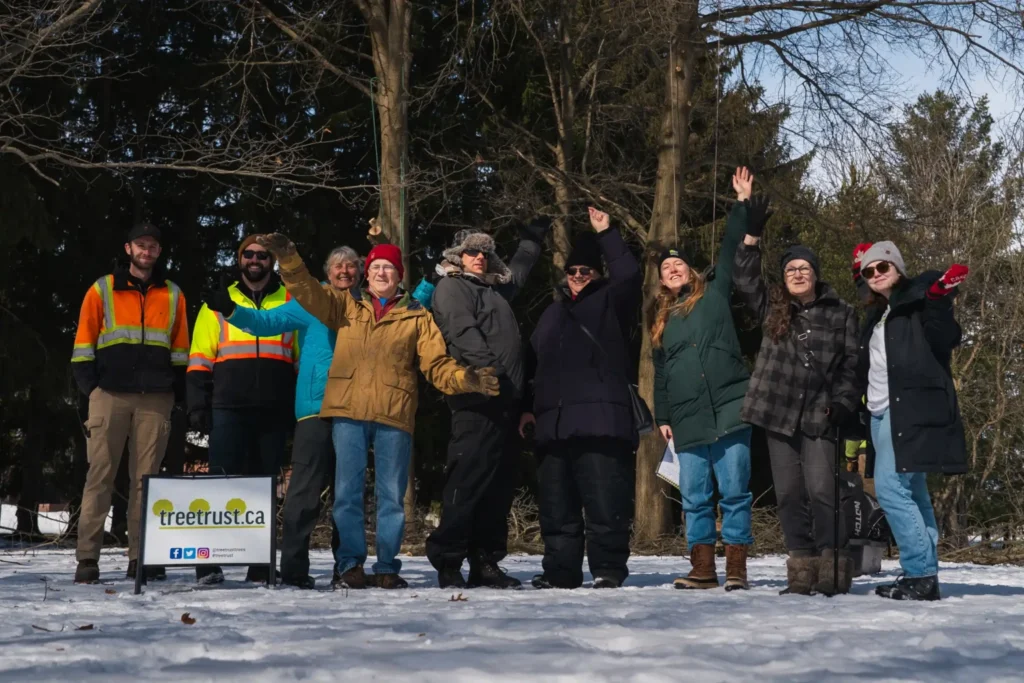
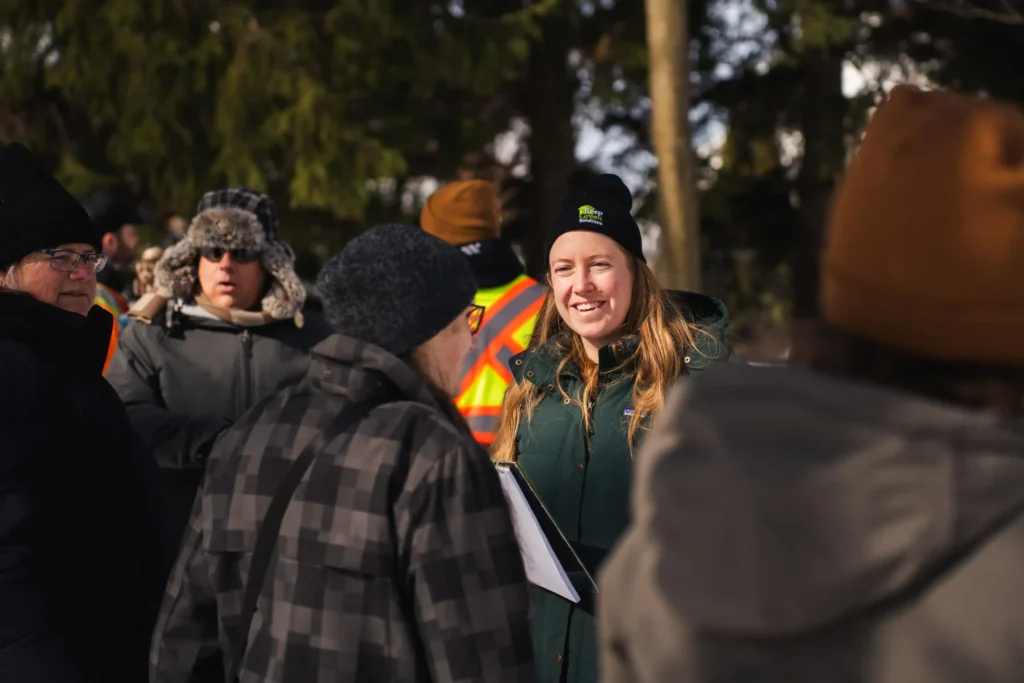
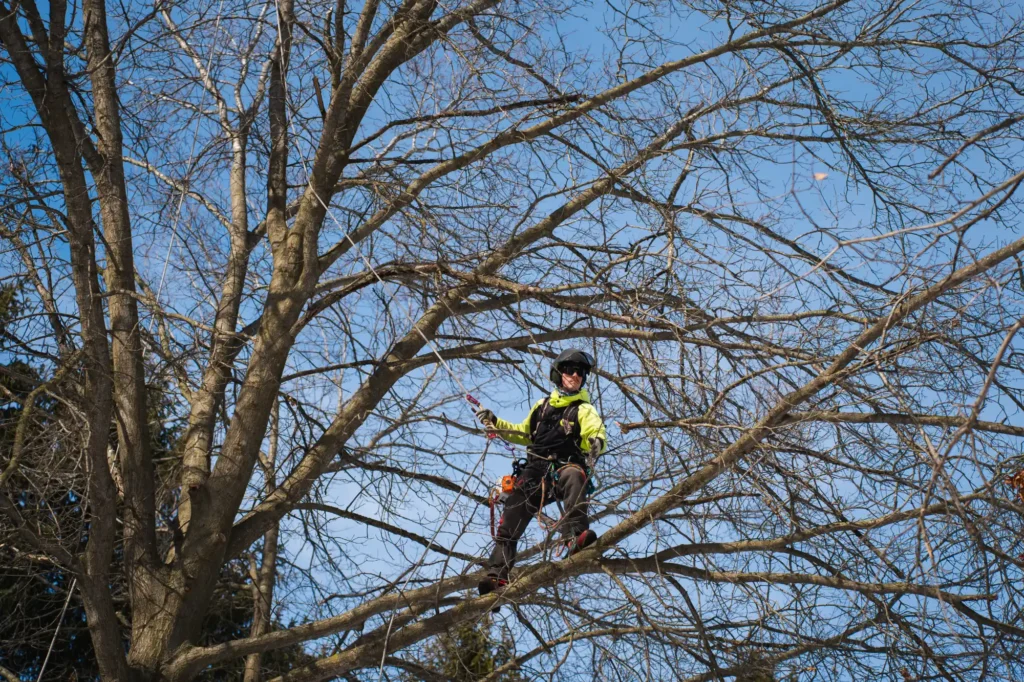
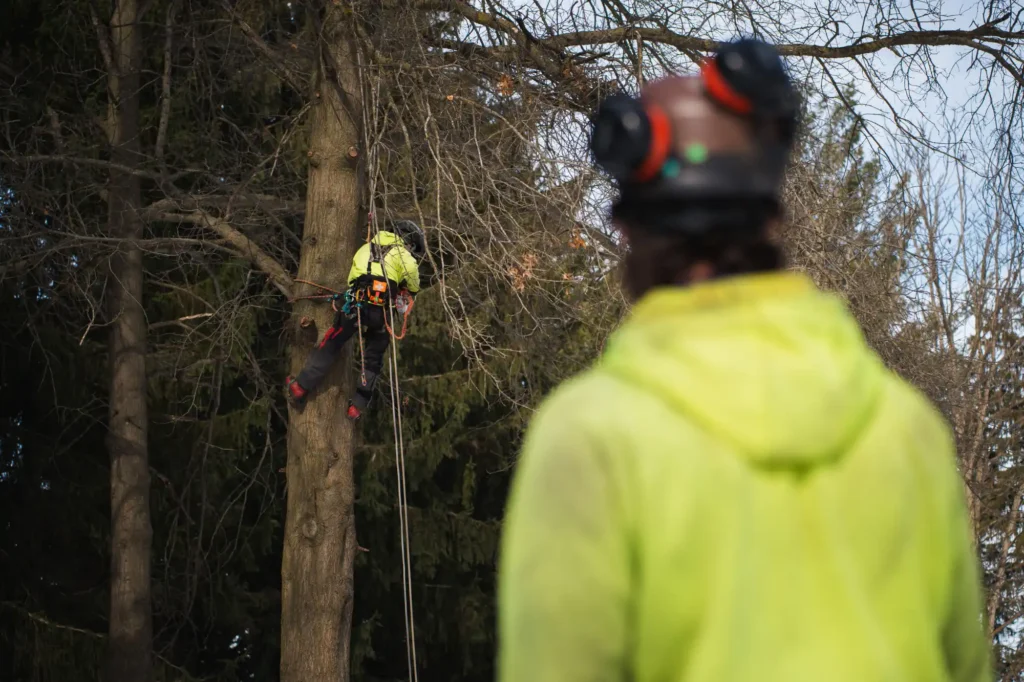
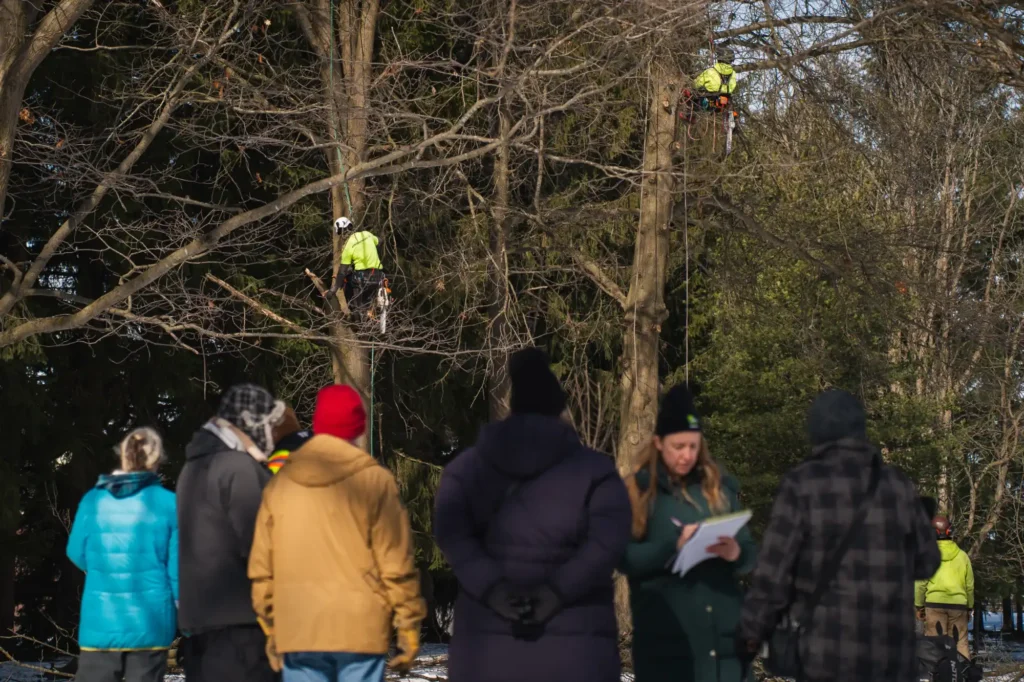
On a cold winter morning in March, a group of Wilmot residents gathered excitedly, watching a team of arborists climb up into the canopy of two pin oak trees in the New Hamburg Arboretum. Local community members, Reep staff, and Tree Trust members all came together to watch. Standing at a distance, we were able to stare up into their bare winter branches. If these oaks could speak directly to us, what would they say? And how could we better listen?
Louis Silcox, one of the attendees, would tell us that to listen to the trees is to stop and observe what is happening—to notice the stories playing out within each tree. “Da Vinci says that ‘to see is to know.’ Most of us don’t see trees, we drive past them,” he shares. Louis is part of a local group called Let’s Tree Wilmot (LTW), passionately organized by Marlene Knezevich in 2020 as a project of Garden Wilmot (Wilmot Horticultural Society). Leading the LTW’s educational walks for the community, Louis brings attention to the importance of the New Hamburg Arboretum by engaging with each tree’s story. He’ll walk a group through the Arboretum and bring them over to the striped maple trees to look at their green bark. He’ll share how they are a rare example of a tree with photosynthetic bark. He’ll incite awe at the wonder of trees, explaining how striped maples can even change sexes under stress, shifting from male to female to be able to reproduce.
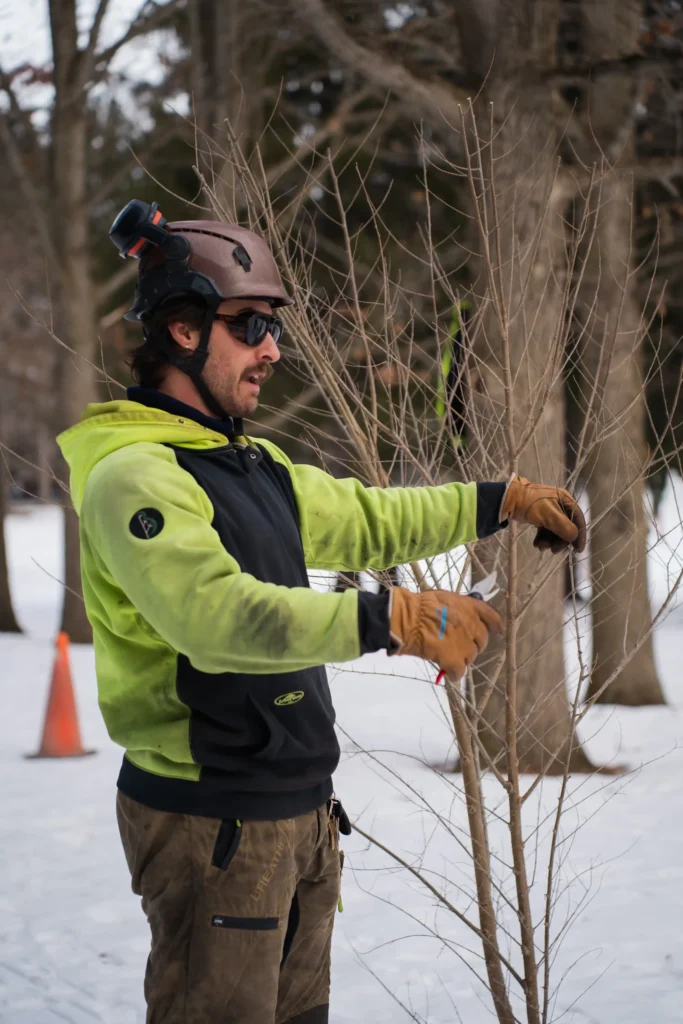
With so many mature trees being cut down and removed in urban settings, how can we listen to their stories? On March 3rd, we gathered in the New Hamburg Arboretum as part of a Tree Trust initiative to conserve mature trees. That day, Tree Trust worked with a team of conservation arborists to prune the two beautiful pin oak trees. The event kicked off with a short demo from Baum Tree Care on how they prune mature trees, using a branch to symbolize an entire tree. The arborists showed us how their team removes deadwood, disease, and carefully reduces the canopy size to ensure that pruned trees can better survive harsh winds and snowstorms without suffering critical damage.
In the case of the two oaks, there was significant deadwood to remove, both to protect the trees and the community members who use the Arboretum as natural trails. Since the 1990s, Wilmot Township has been in charge of caring for the Arboretum, but there has been minimal funding to do so. Recently, with the formation of Let’s Tree Wilmot, the Arboretum’s trees have been able to receive more care and attention because of this group’s support, a small grant they obtained, as well as local donations to this Tree Trust chapter. These important efforts are keeping the Arboretum’s trees thriving. Mature trees are the backbone of our diverse ecosystems and literally cannot be replaced, as they take decades to accumulate the tonnes of carbon they can sequester.
After the demo, the arborists climbed up into the trees while the rest of us discussed the importance of the two pin oaks. We talked about how oak trees are a keystone species within our ecosystem, as they support more lifeforms than any other tree. In fact, they support over 500 species of caterpillars. Over the last 30 million years, caterpillars and oak trees co-evolved, enabling hundreds of caterpillar species to be able to eat oak leaves. This relationship is truly special, because many other native trees only support 100-200 caterpillar species, and non-native trees support even fewer species. Given that caterpillars are an essential food source for baby birds, and our bird populations are declining, oaks have a mighty role in our ecosystem.
After our group shared some oak wisdom, the event turned its focus to observe the arborists. While they climbed high into the branches, we watched excitedly from a distance. As we watched the pruning, conversation turned to how these pin oaks originally were planted in the New Hamburg Arboretum. Yvonne Zyma, another LTW member, has built a strong connection to the Arboretum. She started exploring it every day over 20 years ago, while taking her dog for a walk and dropping her kids off at school. At the time, few people used the park, outside of teens hanging out late at night. She looked around at the different species of trees and began to wonder how they got there. Drawn to learn about its past, she ended up writing a history of the New Hamburg Arboretum after digging through the archives. As she shares, “if people knew more about its history, then they would be intrigued and engaged with its natural beauty.”
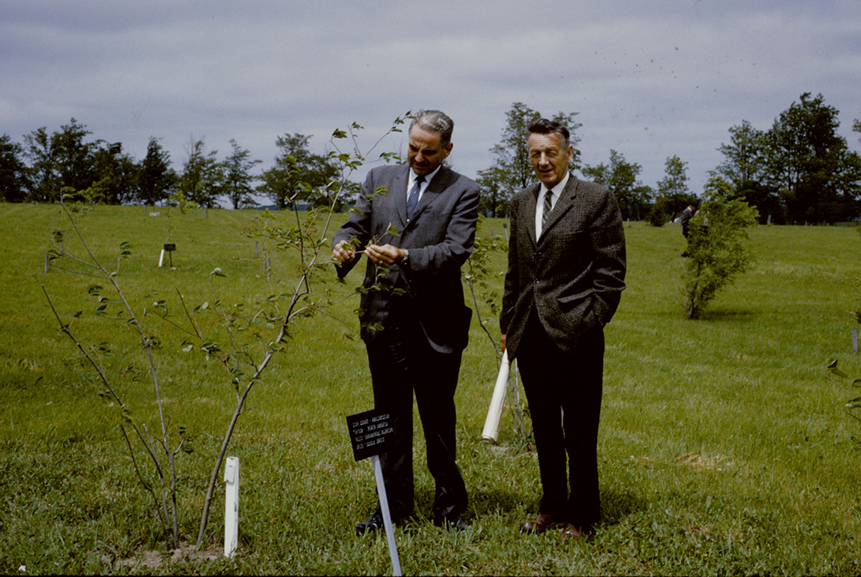
In the 1940s, before it was an Arboretum, the land was used by farmers to study soil runoff using different agricultural techniques. In the late 1950s, trees began to be planted and then in 1964, it officially opened as an Arboretum. It was the second Arboretum to exist in Ontario, and by 1972, there were over 350 trees of 70 different species. Yvonne points out that “at that time it was more of a museum to showcase trees, lots of them being non-native. Now we have more of a focus on the importance of native trees, educating people about assisted migration and how native trees support different species and habitats.” Yvonne sees the New Hamburg Arboretum as a place of “history in action.” For example, the Arboretum has one Osage orange tree that has “huge lumpy fruit that smell incredible.” Although the tree is not native to Ontario, she explained that farmers in the 1900s used to plant this tree to keep their livestock from wandering, because its thorny nature creates a natural fence.
The New Hamburg Arboretum provides a crucial space for community members to engage with the thousands of ecological stories playing out around us at every moment. Some of the trees’ stories help us see into the past, and others help us see into the future. For instance, when Louis takes out a group for a LTW walk, he likes to show them where a tree’s branch had been pruned. He draws their attention to the callus tissue covering the wound, and how this tells us about the trees’ past, the branch that was there, and how long it has been since that branch was cut. He equally pulls people’s vision towards the future, bringing groups over to the ash trees dying in the Arboretum, weaving in stories of the emerald ash borer beetle and its devastating effect on our entire ash tree population. He also gets community members engaged by tying in some pure fun. He’ll announce, “let’s go find some black cherry trees!” or take the group to the Arboretum’s one Kentucky coffee tree and explain how you can make a hot beverage from its seed pods. Wherever he goes, there’s always a story, and always a way to listen to the trees.
When I stand at the foot of any elder tree, I often wonder what stories the tree would tell me from its 50 or 150-year-old life. What birds have nested in its branches, and which caterpillars have overwintered within the crevices of its bark? The impacts of enabling keystone species like these newly pruned oak trees to remain within our ecosystem are immeasurable. In a moment where the world sometimes feels overwhelming, taking a small but meaningful action to protect the trees around us fills me with awe. In the words of E. O. Wilson, “there can be no purpose more inspiring than to begin the age of restoration, reweaving the wondrous diversity of life that still surrounds us.”
Thank you to Iain Murray for the photography. We’d also like to thank Baum Tree Care for their pruning work on these gorgeous oaks! If you’re interested in attending a walk with Louis, you can find out about Let’s Tree Wilmot’s events.
Note: Trees that are pruned by Tree Trust are mostly covered by donations from local community members who care about protecting mature trees. You can donate to your specific township or municipal area to conserve the mature trees in your local neighbourhood.